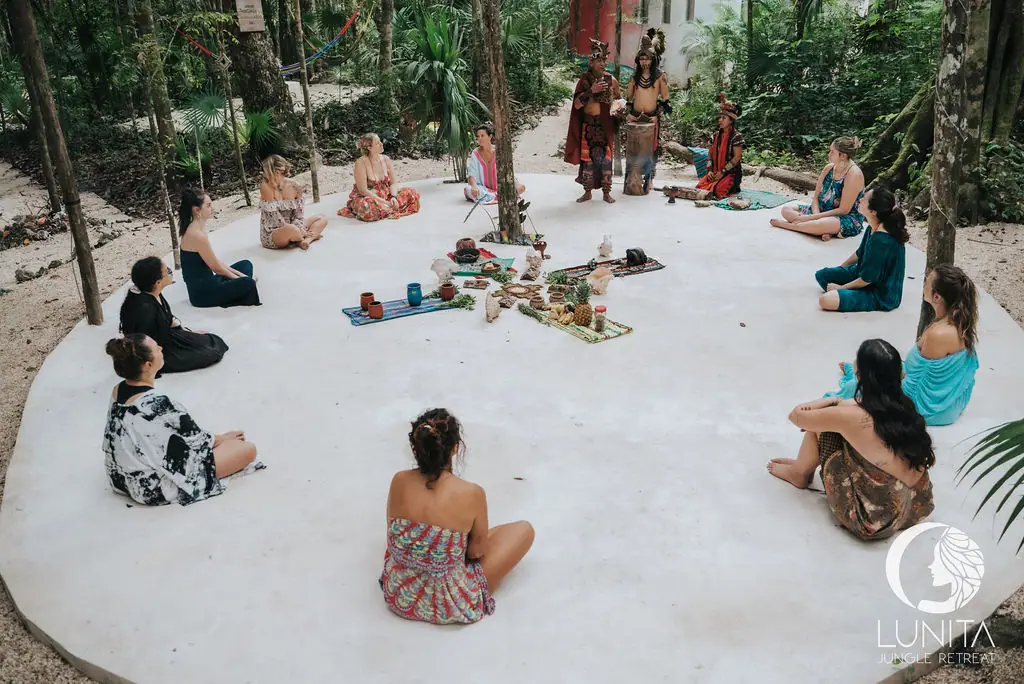
In a world that often asks women to move fast, stay busy, and carry more than they should, a spiritual retreat for women offers something rare: permission to stop, soften, and return to yourself. These retreats are about reclaiming the sacred feminine, body, heart, and spirit. Here's what they offer. (See what a women's retreat is.)
What is a sacred feminine healing retreat?
Stepping out of daily demands, women find rest, reflection, and sisterhood, alongside practices like embodiment, ceremony, and meditation. The invitation is to release what's been over-carried and reconnect with intuition, wholeness, and inner authority, the sacred feminine that busyness so easily buries. The land around the retreat carries its own memory, and the Maya sacred sites of the Yucatán like Cobá can be approached in the same spirit of reverence. For the practice itself, Wikipedia's overview of meditation traditions and research describes the many forms it takes and what studies have measured so far.
The power of sisterhood
Gathering among women creates a particular safety, permission to be vulnerable and witnessed without performance. That shared field often lets deeper remembering surface. The Temple of Remembrance and medicine woman retreats embody this. Explore a personal retreat or book a discovery call.
What the days hold on a women's spiritual retreat
Mornings open early, before the heat, with movement or meditation in the octagonal glass shala. The jungle is loud at that hour and the canopy is on every side, which makes it easy to arrive in the body before the mind has started its list. Breakfast is cooked on site and nobody hurries it.
The middle of the day is quiet by design. Women read in the cabana, float in the cenote-fed pool, or take a session from the service menu that was chosen when they booked. The heavier work, ceremony and circle, sits in the late afternoon or after dark, when the day has softened and there is room for whatever surfaces to settle overnight.
Evenings are the sisterhood part. A circle, a fire, cacao or sound, and then an early night. Most women sleep longer here than they do at home, and the sleep is part of the retreat rather than a break from it.
How to choose a women's spiritual retreat that is real
Ask who holds the ceremony and where she learned it. A retreat built on the sacred feminine should be able to name the women who carry it. A brochure that answers with adjectives has bought the words.
Ask how many women share the space. Lunita holds at most twenty guests across eight cabanas and a mini apartment, and most women's retreats here run smaller than that. A circle of eight to twelve is large enough for a field to form and small enough for everyone to be witnessed.
Ask what you are allowed to skip. The honest answer is anything. A retreat that requires you to share, to cry, or to stay in the room when you need to leave has confused intensity with depth.
What to bring, and what to leave behind
Bring light layers for the shala, something warm for the evenings after rain, a swimsuit for the pool and the cenote, and shoes that can get muddy. A journal is worth more than a second book. The wifi works across the property, so bring the phone, and decide for yourself how much of the week it gets.
Leave behind the plan for what the week should produce. Women who arrive with a list of things to resolve tend to leave with something quieter and more useful: a body that has rested, a voice they remember, and a few women who will still answer a message a year from now.