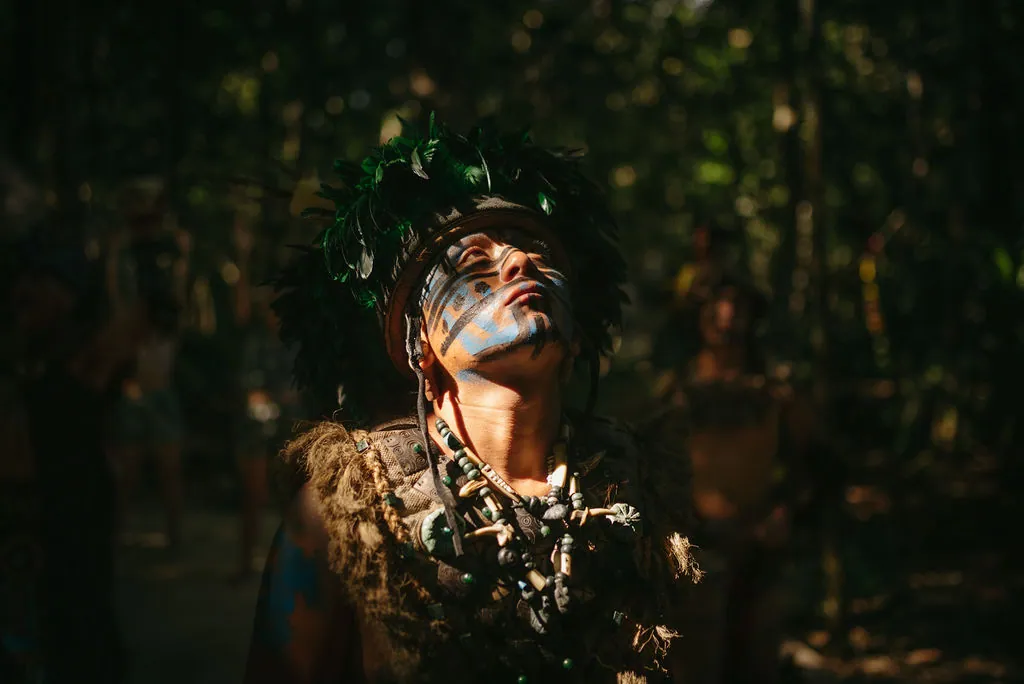
A bufo ceremony works with 5-MeO-DMT, the compound in the venom of the Sonoran Desert toad. The active experience lasts only 15 to 30 minutes, and people frequently describe it afterward as a reset: emotional weight lifted, old material seen from a distance, a clearer sense of themselves. Early research points in the same direction, though it is small and observational rather than clinical proof. This guide covers what participants report, what the studies actually found, and who this medicine is, and isn't, for.
If you're new to the medicine, start with what a bufo ceremony actually is and the honest history of the practice (it's modern, not ancient, and we explain why that matters). This page focuses on outcomes, the pharmacology, and safety. For the science of the molecule itself, see our 5-MeO-DMT & bufo ceremony guide.
If you are reading this because you want to serve this medicine rather than sit with it, that is a different path and a longer one. Here is how to become a bufo facilitator.
Bufo is one road among several, and a peyote ceremony asks something quite different of you.
Others find the slower arc of a mushroom ceremony a better fit.
How 5-MeO-DMT works in the body
5-methoxy-N, N-dimethyltryptamine is a naturally occurring indole alkaloid structurally related to serotonin. Inhaled, it crosses the blood-brain barrier within seconds, faster than virtually any other psychedelic, which is why onset is almost immediate and the experience is so short.
Its main action is as a serotonin-receptor agonist, binding with high affinity to 5-HT1A and 5-HT2A receptors, the same subtypes engaged by some antidepressants, but through rapid, intense activation rather than slow daily modulation. The experience also temporarily quiets the Default Mode Network, the brain system behind self-referential thinking and rumination. When the DMN goes quiet, the ordinary sense of a bounded, narrating self dissolves, a state advanced meditators reach after years of practice, here reached in seconds.
Two practical pharmacological points. First, 5-MeO-DMT is non-addictive and physiologically non-toxic at ceremonial doses, metabolized quickly by MAO enzymes, with no known organ toxicity at therapeutic doses. Early research is also exploring effects on neuroplasticity markers, though that work is still preliminary. Second, and this is non-negotiable, combining 5-MeO-DMT with SSRIs, SNRIs, or MAOIs carries serious risk. Anyone on antidepressants should speak with their prescriber and tell us at intake. See safety below.
The benefits of a bufo ceremony
These are not guaranteed outcomes, individual experience varies a lot, but the pattern in both research and participant reports is consistent.
Relief from depression and anxiety
The most cited study is Uthaug et al. (2019, Psychopharmacology), a naturalistic observational study of 42 people. After a single session, ratings of depression, anxiety, and stress dropped and reached statistical significance at four weeks, reductions of roughly 68% (depression), 56% (anxiety), and 48% (stress), while satisfaction with life and mindfulness rose and held at follow-up. The improvements were strongest in those who experienced the deepest ego dissolution (Uthaug et al., 2019). A separate Johns Hopkins survey found most people previously diagnosed with depression or anxiety reported improvement afterward. These are early, self-reported findings, not clinical-trial proof.
Trauma release
Why that happens is not settled. One proposed explanation is that the ego-dissolution state interrupts the loop by which painful memories are re-experienced and re-encoded with emotional charge, though that mechanism is hypothesised rather than demonstrated. What participants describe is more consistent: seeing difficult material from the outside rather than from inside the wound, and finding that it surfaces and passes without overwhelming them.
Support for addiction recovery
Preliminary research and clinical case reports suggest bufo may support recovery from substance-use disorders, including alcohol and opioid dependency. The proposed mechanism combines neuroplasticity with the profound shift in self-perception that often follows ego dissolution, a reorganization of identity that can make old coping patterns feel less necessary.
Spiritual renewal and a changed relationship to fear
Many participants describe bufo as among the most significant experiences of their lives, a direct, felt encounter with what they variously call the divine, pure consciousness, or ultimate reality. The most consistent long-term report is that their relationship to fear shifted: failure, loss, and mortality became less totalizing, and life felt more navigable.
Emotional resilience and "reset"
Post-ceremony reports consistently include greater emotional openness, reduced reactivity to stress, more self-compassion, and better sleep. The word that comes up again and again in integration is reset, a sense that something fundamental has been cleared and reoriented.
Safety: who should and should not work with bufo
Bufo is not appropriate for everyone, and legitimate practitioners screen thoroughly before every session. This is an orientation to risk, not a complete medical guide.
Absolute contraindications: current use of SSRIs, SNRIs, antidepressants (serotonin-syndrome risk), or MAOIs; a history of psychosis or schizophrenia; severe cardiovascular conditions; an active manic episode or untreated bipolar I. Requires careful screening: a personal or family history of psychotic episodes, other psychiatric medications, pregnancy, recent major surgery or illness, or severe untreated anxiety.
A responsible facilitator conducts a detailed written and verbal intake covering medical history, psychiatric history, medications, and intentions. If a provider offers bufo without screening, do not attend. At Lunita, every participant completes a health intake reviewed by our team before any ceremony is confirmed, and we decline to work with participants whose safety we cannot verify.
What the ceremony and integration involve
A bufo ceremony at Lunita is held one participant at a time in a private jungle space, and runs about two to four hours including preparation, the 15 to 30 minute active experience, and immediate grounding. For the full before/during/after walkthrough, see the bufo ceremony guide.
The benefits above depend on what comes next. Integration is what makes the ceremony matter, the medicine opens a door; integration is the work of walking through it. Lunita builds in a next-day one-on-one, journaling prompts, follow-up support for 30 days, and an optional retreat context of temazcal, cacao ceremony, yoga, and nature that grounds the insight in the body.
Experiencing bufo at Lunita
Lunita Jungle Retreat sits on a private property about 40 minutes from Cancún airport in the Riviera Maya, a setting chosen on purpose. Bufo is offered to screened, qualified guests as part of a personal retreat, and many weigh it against an ayahuasca retreat; our team helps you discern which medicine fits your moment. The honest first step is a conversation, book a free discovery call.
If sitting with the medicine is what you are here for, our bufo ceremony page explains how we hold it at Lunita and how to begin.
If you take SSRIs, SNRIs, or other serotonergic medications, speak with your prescribing physician and tell us at intake; our screening will tell you directly if ceremony is inadvisable. Never self-discontinue psychiatric medication. This is a medical safety requirement.