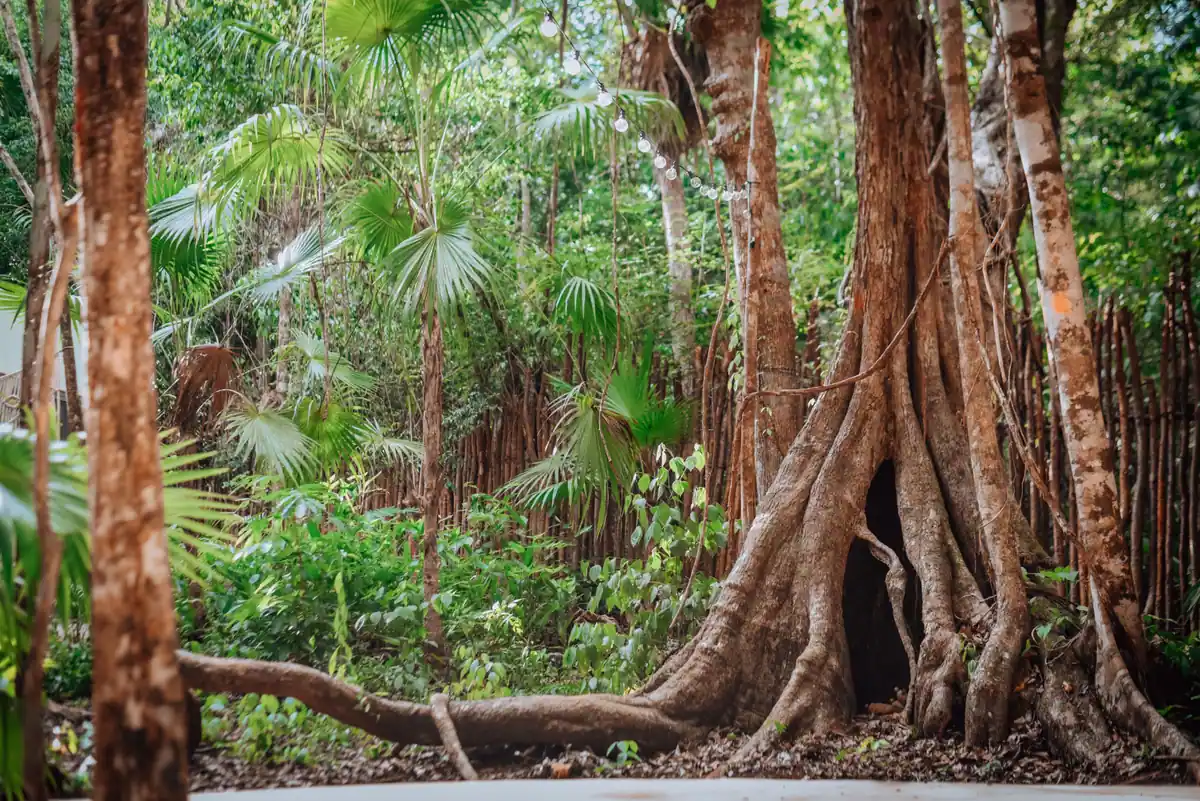
At Lunita Jungle Retreat, we believe in living in harmony with nature, which is why we chose an ecological, off-the-grid approach. Our commitment to sustainability stems from deep respect for the environment and a desire to preserve its beauty for generations. Here's why Lunita is a genuinely eco-friendly retreat center. (See our eco sanctuary page.)
Why off-grid
By choosing to go off the grid, we've embraced a self-sufficient lifestyle that reduces our carbon footprint and promotes environmental stewardship. The journey has had real challenges, but it's been deeply rewarding, we've created a sanctuary that thrives alongside the natural world rather than at its expense. Sustainability here is lived, not labeled.
What it means for your stay
The retreats held on this land, from solo stays to full groups, are on our retreats page.
For guests, off-grid means staying somewhere genuinely connected to nature, where the quiet runs deeper and the experience feels more grounded. Woven with ceremony and practice, an eco-conscious retreat lets you rest knowing your time here treads lightly. Book a discovery call to learn more. If what you are looking for is somewhere to recharge without leaving a heavy footprint, here is why Lunita makes a genuinely eco-friendly jungle escape.
How does the property actually run?
Power comes from the sun and is stored in five batteries on site. That covers every light, fan and socket on the property, the kitchen, the pumps and the Starlink that gives the whole place wifi. The one thing it changes for a guest is awareness: on a run of grey days the team may ask for a lighter hand with the sockets, and a hairdryer is the appliance most likely to be left at home.
Water is drawn from the cenote beneath the land and returned to the ground through a biodigester after use. The soaps in the bathrooms are chosen because the water goes back to the aquifer, and guests are asked to use those rather than their own.
The trees do the rest. More than five thousand were planted and none were cut for the build, so the cabanas were fitted between what was already growing. Shade is the cooling system, and the dry season nights are cool enough that most guests sleep under a sheet.
What a stay asks of you, and what it gives back
It asks for a few habits. Short showers, the provided soap, no single use plastic through the gate, a torch rather than the path lights after the shala closes. None of it is enforced with signs; the team mentions it on arrival and guests pick it up from each other.
What it gives back is quiet of a kind that is hard to describe until you have slept in it. No generator, no traffic, no air conditioning cycling on at three in the morning. Birds at first light. A sky that is fully dark. Guests who came for a practice often say afterwards that the nights were the practice.
Eight cabanas and a mini apartment hold at most twenty people, which is another kind of ecology: the land is never asked to carry more than it can, and neither is the circle.