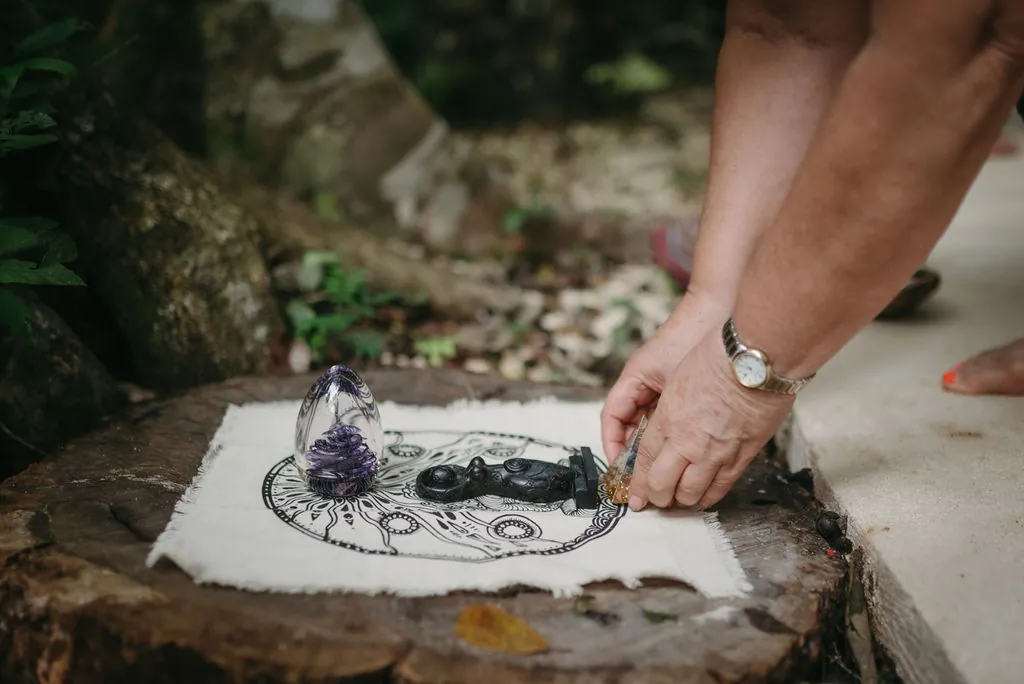
Despite what you will read on many retreat websites, the bufo ceremony, smoking the 5-MeO-DMT, rich venom of the Sonoran Desert toad (Incilius alvarius, formerly Bufo alvarius), is a modern practice, not an ancient one. The compound was first identified in the toad's venom in 1965, and the ceremony as we know it was popularized in 1984 by a pamphlet from Ken Nelson, who wrote under the name "Albert Most." There is no verified record of indigenous peoples smoking toad venom in antiquity. The honest history is more interesting than the myth, and at Lunita we would rather tell it straight. (New here? Start with what a bufo ceremony is.)
Was bufo really used in ancient ceremonies?
The popular "thousands of years of indigenous use" story is not supported by the evidence. A few facts that get blurred together:
- Toad imagery is real, but it's the wrong toad. Mesoamerican art (Olmec, Maya) does feature toads, but it points to Bufo marinus, the cane toad, whose glands produce bufotenine, not the 5-MeO-DMT found in Incilius alvarius. They are different compounds with different effects.
- The famous "ritual toad bones" weren't ritual. Early reports of toad remains at the Olmec site of San Lorenzo were later re-examined; more thorough excavations concluded the deposits were most likely natural, not cultural.
- Scholars have a name for it. A 2026 peer-reviewed analysis describes the trend as "fabricated ancestrality", a modern practice dressed in an imagined ancient lineage.
Where 5-MeO-DMT does have a lineage
This is the part that often gets lost: the molecule 5-MeO-DMT is genuinely ancient, just not via the toad. It occurs in plants such as Anadenanthera and Virola, and peoples of South America and the Caribbean (the Yanomami, Tukano, and Taíno, among others) have used these as ceremonial snuffs, yopo, cohoba, vilca, for centuries, insufflated through carved tubes rather than smoked from an animal. So the honest framing is simple: 5-MeO-DMT in plant form is ancient; the toad-venom ceremony is modern.
The modern rediscovery (1965 to today)
- 1965 to 1967, pharmacologist Vittorio Erspamer and colleagues identify 5-MeO-DMT in the toad's venom; the findings circulate in scientific circles.
- 1984, Ken Nelson, as "Albert Most," publishes Bufo alvarius: The Psychedelic Toad of the Sonoran Desert, describing how to collect and smoke the venom. This is the true origin point of the ceremony.
- Chemistry, Alexander Shulgin's work helped map 5-MeO-DMT's pharmacology to its profound subjective effects.
- 2000s onward, the ceremony spreads into retreat settings, especially the Riviera Maya, amplified by celebrity stories and media coverage.
The ethics: protecting the toad
This surge has a cost. Milking a wild desert animal at scale stresses both the toad and its fragile habitat. The good news is chemical: synthetic 5-MeO-DMT is identical to the toad's, and many ethical facilitators now work with synthesized medicine so no animal is harmed. Honoring the practice today means honoring the toad, and the original peoples of Sonora where this story began.
What the ceremony means now
None of this diminishes the experience. Whether the lineage is ancient or recent, what participants describe is real and lived:
- Death and rebirth, many describe "dying" into pure consciousness and returning with clarity and peace
- Union, the dissolution of ego into a felt sense of connection with all that is
- Release, the surfacing and clearing of deeply held emotion and trauma
Meaning doesn't require antiquity. A practice can be young and still be sacred when it is held with integrity.
How Lunita holds bufo
We don't sell a false ancestry. We honor the broader Mesoamerican relationship with sacred medicine and the genuine plant lineage of 5-MeO-DMT, we favor ethical and sustainable sourcing, and we surround the ceremony with a traditional temazcal, cacao ceremony, sound healing, and real integration. If you feel called not only to receive the medicine but to serve it, Lunita also runs a Bufo Practitioner Training rooted in safety, ethics, and integration, reach out to learn more.