You Will Come Back to Me
La limpia
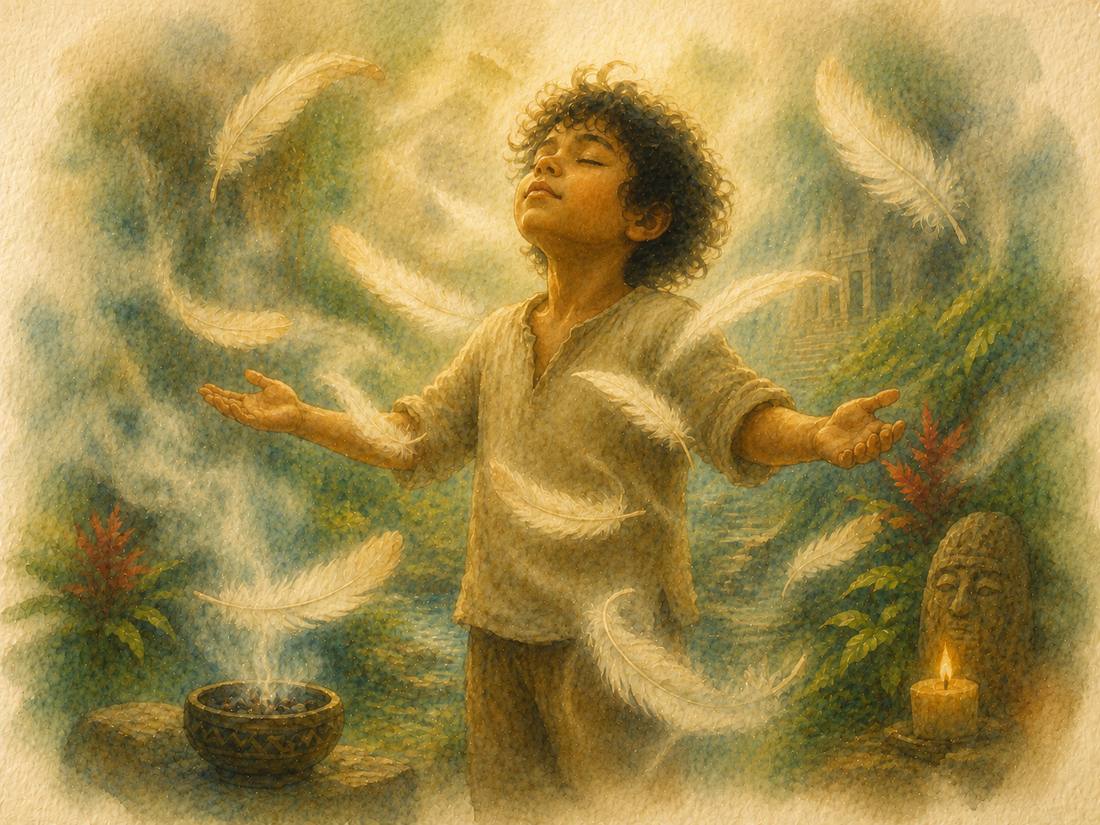
La limpia
The Wings That Sweep
"Have you ever," says Grandmother, "felt a weight on you that you can't see? Not on your shoulders. Deeper inside. A day that went wrong, a sadness, a fear you carried around without even noticing. Well. For that kind of weight, here with me, there is something very old. Let me tell you."
Do you know what it means to clean?
Of course you do. You take the broom and sweep the dust out of a room. You take away what makes it dirty, what isn't needed, and the room is clean again, lovely, light. You breathe better in a room that has just been cleaned.
Good. Now I'll tell you something you might not know: the soul can be swept too.
Yes. Because inside us too, just like in a room, dust piles up. Not the kind you can see. It's another kind of dust: ugly thoughts, fears, tiredness, the unkind words someone said to us that stayed stuck on us. None of it can be seen, but it weighs. And every so often it needs to be swept away, exactly like the dust in a room.
That cleaning of the soul, here, is called a limpia. And this is how it's done.
First, you remember, there is the copal: the sweet smoke that opens everything, that gets things ready, that says: now we begin. The shaman lights the copal and wraps himself in its smoke. Then he takes in his hand the very best thing there is for sweeping a soul.
Feathers.
And here is the secret, children, listen closely because it's beautiful. Why feathers, of all things? So many other things could be used, so why feathers?
Because feathers come from flight.
Think about it. A feather was once on a bird. And that bird flew, high, light, close to the sky. The feather knows the air. It knows what is high. It knows how to rise. It's a little piece of sky that fell to the ground.
So when the shaman passes the feathers around a person's body, slowly, from top to bottom, front and back, the way you sweep with care, those feathers do something magical. They gather up all the weight, all the invisible dust, all the sadness stuck on. And then, because they know how to fly, they carry it away. Up high. Far away. Where it can't hurt you anymore.
The feather sweeps the earth and sends it to the sky. It takes the weight off you and lets it go up, where the air carries it off.
In a real limpia, this is the most important moment. The copal smoke opened the way, but it's the feathers that do the big work: they pass over you, patiently, everywhere, and with every pass you feel a little lighter. As if someone were taking out, one by one, all the little stones you had put in your pocket without noticing.
And when it's over, it's a strange and sweet thing. You open your eyes and the world looks cleaner. You feel cleaner. Not your skin, that's the same as before. Something has changed on the inside. You breathe better. You smile for no reason. You feel like a room that's just been swept, with the window open and fresh air coming in.
That's why, when you're grown up and you feel that weight you can't see (and it will happen, it happens to everyone), remember the feathers.
You don't always need a shaman, you know. Sometimes it's enough to stop. Close your eyes. Breathe slowly. And imagine two big, light wings passing over you, from top to bottom, carrying away what weighs, up high, where the air dissolves it.
The jungle taught you this: everything that weighs can be swept away. And everything that flies, sooner or later, becomes light again.
Grandmother makes a gentle gesture in the air, as if she were holding a feather. "There," she says. "One pass for you too, before you sleep. Away with the day that went wrong. Away with the fears. Just you left, light. Now you'll sleep well."
Ojo de Dios
The Eye That Keeps Watch
Grandmother picks up two little branches laid in a cross and a ball of colored threads. "Come close," she says. "I'm going to show you something with my hands. But don't just watch what I do. Watch how I do it. Slowly. Always slowly."
It's called Ojo de Dios. The Eye of God.
It's made of two little sticks laid in a cross, like this, one on top of the other. And then of thread. Colored thread, that winds around the cross, up and down, over and under, always in the same direction, always with the same rhythm. And little by little, turn after turn, an eye is born. A big eye of yarn, made of many colors, that seems to be looking at you.
The old ones made it for this: so that it would keep watch. They hung it where there was something precious to protect: a newborn baby, a house, a field of corn. The Ojo de Dios stayed there, hanging, and watched. It kept watch over what was loved, even when real eyes had to close to sleep.
But now I'll tell you the real secret, the one that isn't in the sticks or in the threads. It's in the hands.
Watch my hands while I make it. Up. Turn. Under. Turn. Up. Turn. Under. Always the same. Always slowly. It's a slow movement, with a rhythm, that is never in a hurry. Like the waves that come and go. Like your breathing when you sleep. Like the rocking of the hammock. Up. Turn. Under. Turn.
And here is the magic I've seen happen a thousand times, and that moves me every time.
When I make an Ojo de Dios and there's a little child nearby (a tired child, maybe, one of those who don't want to sleep and fidget and cry), that child starts to watch my hands. Up. Turn. Under. Turn. And can't look away anymore. The child follows the thread going round, follows the color being born, follows the slow rhythm of fingers that never miss a turn.
And little by little the eyes get heavy. The breathing gets longer. The little hands open. And without noticing, because a slow rhythm is the oldest lullaby in the world, older than words, older even than songs, that child finds rest. The child falls asleep watching an eye being born, while another eye, the one made of yarn, is already beginning to keep watch.
That's why the colors aren't chosen at random, you know. Each color is a wish. Red, for the strength of blood and of the heart. Yellow, for the sun and for the corn that keeps us alive. Blue, for the water and for the sky, which are always up there even when we can't see them. Green, for me, for the jungle, for everything that grows. When I make an Ojo de Dios for a child, I choose the colors the way you choose the words of a prayer: carefully, one by one, thinking of that child.
You try it too, when you're grown up. Two little sticks, a bit of thread, and a lot of calm in your hands. Make one for someone you love. While you make it, think of them with every turn. And when it's finished, hang it where they sleep.
That way, even on the nights when you are far away, there will always be an open eye keeping watch over the one you love.
And it's the sweetest way I know to tell someone, without words: even when I'm not here, I'm watching over you. Sleep easy.
You Will Come Back to Me