You Will Come Back to Me
The Copal
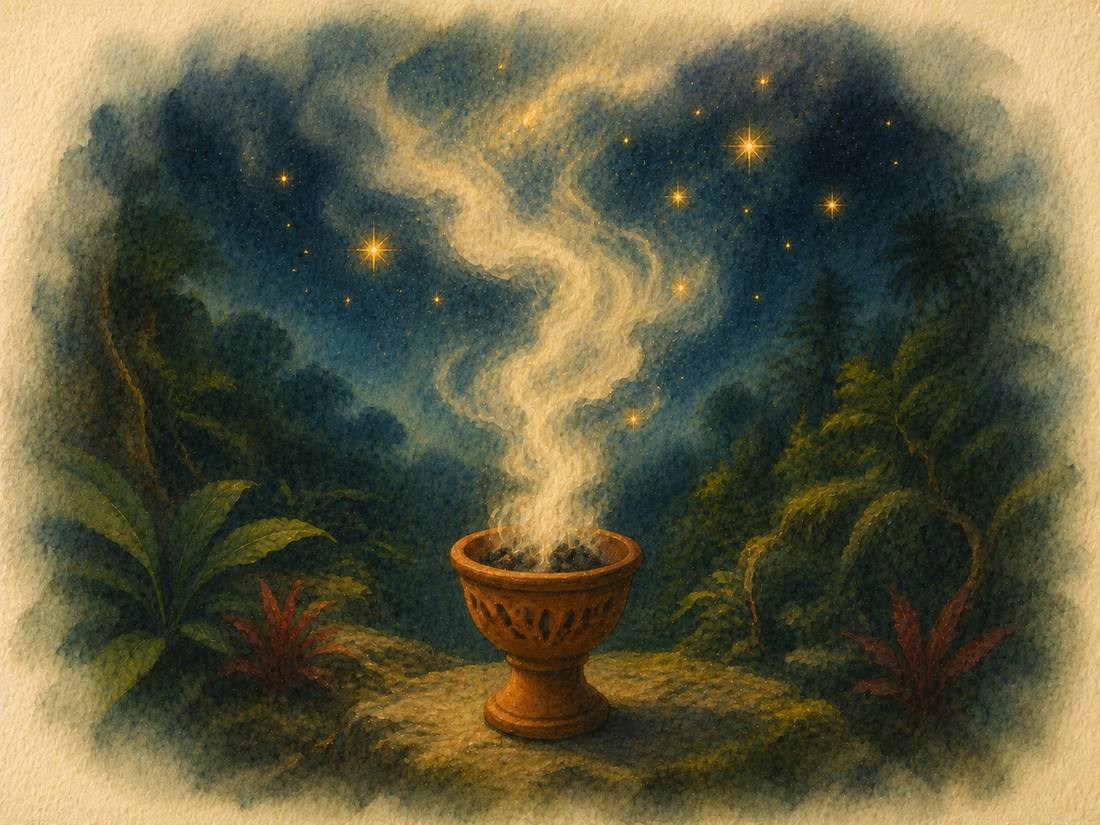
The Copal
The Scent That Rises
Grandmother sniffs the air. "Do you smell it?" she says. "That sweet scent, a little bit of earth and a little bit of sun. Something has begun. When you smell this scent, it means something important is about to happen. Let me tell you."
I want to tell you about a tree's tear that becomes a prayer.
Yes, you heard me right. It starts with a tree, like almost everything here with me.
There is a tree, in the jungle, that keeps a treasure inside itself. You can't see it from the outside. It is in the trunk, in the branches, like a secret. And when the tree is wounded, a small cut in the bark, nothing more, no blood comes out of that wound. Out comes a golden drop, fragrant, slow. A tear.
The tree cries, and its tear is a gift.
The drop runs down slowly, hardens in the air, and becomes a little see-through stone the color of honey. That stone is called copal. And the ancient ones called it, in their language, with a single, beautiful word: poom.
But pay attention, because here there is something you need to learn. Whoever gathers copal cannot wound the tree however they like. They have to make a small cut, precise, gentle, so that the wound can close again. And then they have to leave the tree in peace for two, three years, to rest, to heal. Because if it is wounded too much, the tree dies. And a tree that dies cries no more golden tears.
Do you understand? Even to receive the most sacred gift, you have to respect the one who gives it to you. You ask, you don't tear it away. It is always the same pact, the one I have been telling you about since I first started telling you stories: the jungle gives you everything, if you treat it with love.
So what do people do with this golden tear?
They bring it to a small clay bowl. A burner. It is called a sahumerio, and it is made of clay baked by fire, which means it is made of earth too. Think how beautiful that is: the earth, hardened by fire, holding the tear of a tree in its lap. One thing from the jungle holding another.
Inside the sahumerio are the embers. The copal stone is placed on top. And as it warms, it starts to melt, and to smoke. A white smoke, thick, fragrant, that tastes of sweetness and earth and sun all at once. And that smoke rises. It rises, and rises, up and up, toward the sky, toward the stars, toward the fires of the ancestors I told you about.
Because this is the secret of copal: its smoke is a prayer that walks. Everything you have in your heart, a thank you, a wish, the name of someone you love, rises with that smoke and reaches up there. The ancient ones said it was the food of the gods. I'll only tell you that it is the oldest and sweetest way people have found to speak with those who are up high.
Here with me, there is always copal. It is alive, like me.
When new guests arrive, tired, still full of the noise of the world they come from, the first thing we do is light the copal. To take the tiredness off them, the noise, the thoughts. To say: now you have arrived, now you can put everything down.
And there is an even more important moment. When a person is about to enter a sacred space, first they take off their shoes, always, because I've already told you how much bare feet matter to me, and then they stop in front of the shaman. It is the shaman who lights the copal, he who knows the right words, the true ones, which I won't tell you because they are not mine to give. And the person is asked only one thing: to open their arms, like this, out to the sides. Like a tree opening its branches. Like someone who has nothing left to hide.
And then the copal smoke goes all around the body. In front, behind, under the open arms, from the head down to the bare feet. And it carries away what weighs. It is a limpia, a cleansing, but not of the skin: of the soul. It is also done before entering the temazcal, always, before crossing the threshold.
When you come out of that smoke, with your arms still open, you are lighter. You can feel it. You have left something on the ground, and you don't quite know what, but you breathe better.
That is what copal is, children.
A tear a tree cries for you. A prayer that walks toward the sky. And a way, as old as this land, of telling you: put down what weighs. Open your arms. Now you are home.
Grandmother closes her eyes for a moment in the scent. "Whenever you grow up and, anywhere in the world, you smell this smell of sweetness and earth," she says softly, "stop. Open your arms. And for a moment you will be here again, with me."
The Ayoyotes
The Seeds That Count Time
A new sound can be heard. A rhythmic rustle, like lots of little pebbles, like light rain, like something walking through the leaves. "Ah," says Grandmother, and she closes her eyes. "Those. Listen to them. They hold a secret as big as the sky."
Do you hear this sound? Shh-shh, shh-shh. It sounds like rain. It sounds like a snake sliding through dry leaves. It sounds like time itself walking.
These are the ayoyotes.
And like almost everything sacred here with me, they start with a tree. There is a tree that makes fruits, nuts. When these nuts dry, they go hollow inside, and the little seeds left in them, moving around, knock against the walls and make that sound. Shh-shh. The jungle, all on its own, had already invented its first instrument. People only had to pick it up.
Lots of nuts are tied together and fastened around the ankles. Around bare feet, always bare feet, you know that by now. And when a person dances, with every step, with every movement, the ayoyotes sound. Shh-shh, shh-shh. It is the body making music just by moving.
But now I'll tell you the secret, the one as big as the sky. Hold on tight.
Inside the ayoyotes there are fifty-two seeds. Not one more, not one less. Fifty-two. And do you know why that number?
For two reasons. And both of them are wonderful.
The first: fifty-two is the number of joints in your body. That is, all the places where the body bends, moves, dances. Fingers, wrists, knees, elbows, neck... count them one day, there are exactly fifty-two places that make you move. Your body, to dance, uses fifty-two joints.
The second: fifty-two is the number of years in the great calendar of the Maya. They had two ways of counting time, and every fifty-two years those two ways lined up again, came back together, and there was a celebration: the world had closed a whole circle and was starting a new one. Fifty-two years: one complete circle of time.
Do you understand what that means?
It means that when you dance with ayoyotes around your ankles, a kind of magic happens. The fifty-two joints of your body, moving, make the fifty-two seeds sound, and they are the fifty-two years of the world. Your small body, dancing, repeats in a few minutes the great turning of the sky. You yourselves become the calendar. You yourselves become time going round.
The small and the great, the same thing. As always, here with me.
That is why, for the ancient ones, dancing was not a game. It was almost a prayer. A sacred moment. People danced to give thanks, to ask for rain, to speak with the sky. And the sound of the ayoyotes carried everything upward: the steps, the breath, the beating of the heart.
Because this is the most beautiful thing about their sound, and someone who knows how taught me to listen to it well. The sound of the ayoyotes is not just one sound. It is all the sounds of the jungle mixed together. There is the patter of rain on the leaves. There is the rustle of the snake in the grass. There is the rhythm of time flowing, always the same and always new. There is the beating of the heart, your drum, do you remember? And there is so much more, because everyone hears their own thing in it.
That is why the ayoyotes are also a way to stop your thoughts. Yes. When their sound keeps going, steady, shh-shh, shh-shh, the mind calms down. It stops running. The thoughts line up and slow down, and follow that rhythm, and little by little they go quiet. It is a kind of meditation: not with words, but with sound. The noise that teaches the head to be silent.
Try it one day. Close your eyes and listen to that sound that is rain and snake and heart and time, all together. And let your thoughts follow it, slowly, until they stop.
You will notice that, underneath all the thoughts, you were always there. Calm. Like the jungle at night.
Grandmother opens her eyes. "Fifty-two seeds," she murmurs. "Your body and the whole sky, in the same little sound. Who would have thought it, eh? And yet it's true. The biggest things are always inside the smallest ones."
You Will Come Back to Me