You Will Come Back to Me
The Cave That Breathes
The Princess Who Became Jungle
"This one," says Grandmother, lowering her voice, "I didn't see with my own eyes. The wind told it to me, and the wind sometimes embroiders. But I believe it's true. Beautiful stories are always a little bit true. Listen."
A long time ago, when the men from across the sea arrived with their weapons that made fire, there was a princess.
Not a princess in golden dresses like in the fairy tales you know. A Mayan princess: the daughter of a lord of this land, with skin the color of my red earth, hair black as water at night, and eyes that knew how to read the sky. She was young. She was brave. And that day she was running to save her life.
The invaders had taken her village. They had torn down the temples, put out the fires, and they were looking for her, because whoever conquers a land always wants to take the one who loves that land most. And she ran. Barefoot, in the night, inside me.
She ran and I watched her. And I felt her heart beat like a drum gone wild. Tum-tum-tum-tum. I felt her short breath. I felt, behind her, the heavy steps of those who chased her, and the voices, and the dogs.
Then I did the only thing a jungle can do for a child it loves.
I hid her.
I closed the branches behind her as she ran, so the path would vanish. I made the bushes grow thicker, the vines more tangled. I sent the mist to confuse those who searched for her. I made the birds sing the wrong way, to send the pursuers in the opposite direction. And when she, exhausted, fell to her knees in a small clearing, at the foot of a great ceiba, with no breath left to run, I covered her.
I covered her with leaves, with moss, with shadow. I made her, for one whole night, impossible to tell apart from me. The pursuers passed within a few steps of her and did not see her. They saw only jungle. Only green. Only me.
And when the sun came back, and the danger had passed, she stood up. She was safe.
But from that night on, says the wind, something of her stayed in me, and something of me stayed in her. She never truly left. She lived a long life, had children, and her children had children, and so on until today. And every now and then, even now, a girl is born here who runs barefoot without fear, who talks to the trees, who moves through the jungle as if the jungle were her home and protected her.
When you see one like that, and you know one very well, she runs along the little paths and gives her hand to strangers, look at her with respect.
Maybe she's just a happy girl.
Or maybe it's the blood of that princess, running free again in her jungle. At last, after so long, with no one behind her to flee from.
Grandmother falls silent. Then she smiles. "I know what I believe," she says. "But I won't tell you. Some things are lovelier to think about on your own."
The Cave That Breathes
Grandmother leans in, as if to share a secret.
Children, has it ever happened to you to walk through the jungle on a windy day and suddenly hear what sounds like a deep breath?
You stop. You look around. There are no people to be seen, no animals. So who, or what, could have made that breath?
And like all children do, because curiosity comes before anything else, you set out to look. You explored. You stood perfectly still, holding your breath, to work out where the sound came from. And then, there it was: you found it.
It came from a cave.
"But how," you will say, "a cave can't possibly breathe!"
And yet I, who am old and have seen a great deal, and have heard more than one cave breathe, assure you that it is possible. Not all of them do, it's true. But the ones that do, do it for a reason.
And it is about one of these caves that I want to tell you. Because its sound was not really a breath. It was more of a sigh. You know the difference, don't you? We breathe to live. We sigh when we carry something in our heart: a longing, a waiting, a memory that will not go away.
Once a chubby boy with hair red as the sunset came closer to understand the reason for those sighs. He put his ear against the cool stone at the mouth of the cave, and listened.
And no. Wait. Maybe it has gotten late, and we can find out another time?
No?
All right, all right. I'll tell you a little longer. But then everybody to bed, hm?
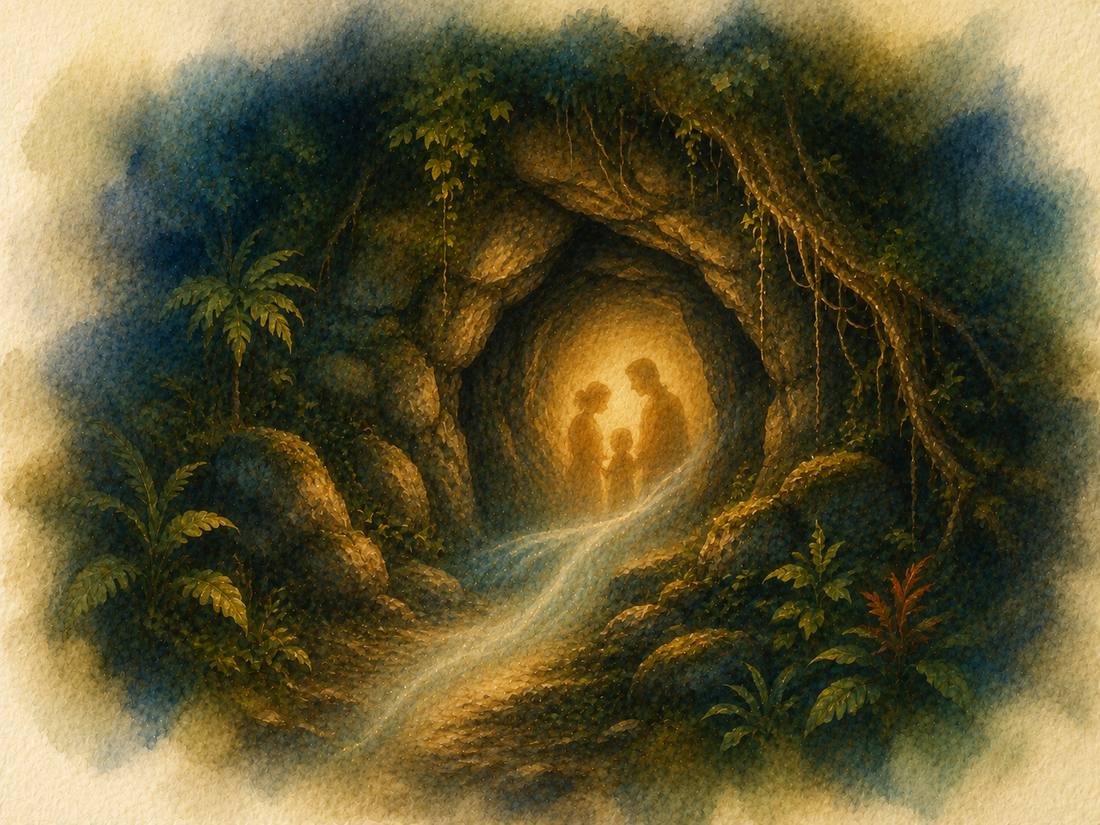
Now then. You must know that long, long ago, in a time so far back that houses were not yet built, a family lived in that cave.
Yes, because before houses, people lived like this: in caves, which the earth offered already prepared, cool in summer and warm in winter. And in this cave, for many years, a whole family had lived.
There was a grandfather, his back bent by work and years, but with eyes that still laughed. There was his son, strong and gentle. And there was the son's wife, a woman with a magnificent voice, one of those voices with real power: hearing her sing was enough for the bad mood to leave, the tiredness to pass, even crying children to calm down. She sang while she cooked, she sang while she wove the baskets, and the cave filled with her voice and held it, the way a scent is held.
And then there were the three children.
The eldest was called Balam, which means jaguar, because from the time he was small he was not afraid of the dark and moved through the night like a lord of the jungle. The middle child, a girl, was called Nicté, which means flower, because she was sweet and opened to the sun, and wherever she passed joy was born. And the youngest, chubby and laughing, was called Itzal, which means morning dew, because he had arrived at dawn on a rainy day, fresh and new as a drop.
And the cave loved them.
Yes, because caves feel. They feel the small steps running, they feel the laughter bouncing off the walls, they feel the voice singing and the children sleeping, breathing softly in the dark. And that cave, all those years, was happy. It was full. It was home. Every morning it woke to the smell of the fire and the racket of the three little ones, and every evening it fell asleep to the lullaby of the woman with the magnificent voice.
They were beautiful years. The cave asked for nothing more: only those steps, that laughter, that voice.
Then, as always happens, and you know this already, I taught you, the children grew up.
Balam became a man and went to hunt far away. Nicté, the flower, truly bloomed and followed her heart to another village. And even little Itzal, the morning dew, one day put his things in a sack and left, because that is what children do: they go. It is right that they go. It is the law of the world, and it is not sad, or not only.
The grandfather and then the parents too, in time, went on, on that journey we all take sooner or later, and of which the Xolo has already told you: so you know they did not go alone.
And the cave was left empty.
For the first time in so many years, no steps. No laughter. No voice singing.
And that is when the cave began to sigh.
Not out of despair, mind you. A cave is old and wise like me, and knows that children have to go. It sighed for another reason. It sighed because it had found a way, the only one it had, not to be forgotten.
When the wind blows, you see, and slips into the deep galleries of the cave, and then comes out of the mouth, it makes that sound. That long breath. That sigh. And that sigh flies far away, among the trees, to where its grown children were living their lives.
And that sound said, to whoever knew how to listen: I am still here. I have not gone anywhere. When you want to come back, follow my breath, and I will bring you home.
And here is the most beautiful thing, children. The thing worth staying awake a little longer for.
The children had not forgotten it.
Balam, Nicté and Itzal, even grown, even old, came back now and then. They followed that sigh on the wind, found the path again, and came to spend a little time inside it. They sat in the coolness of the stone, where they had slept as little ones, and told the cave about their lives. And the cave listened, content, and for a few hours it was full again.
And when they left again, the cave began to sigh once more. Not out of sadness. Out of waiting. Because waiting, when you know someone will return, is not pain. It is love breathing.
That is why some caves sigh, children.
They are not empty. They are mothers of stone who have learned to call their children with the wind. And who know, as I know, as the whole jungle knows, that whoever has been loved, sooner or later, always comes back.
Grandmother smiles. "Now it really is late," she says. "But if one day, walking, you hear a cave sigh… stop. Someone is waiting for you. And knows your name."
You Will Come Back to Me