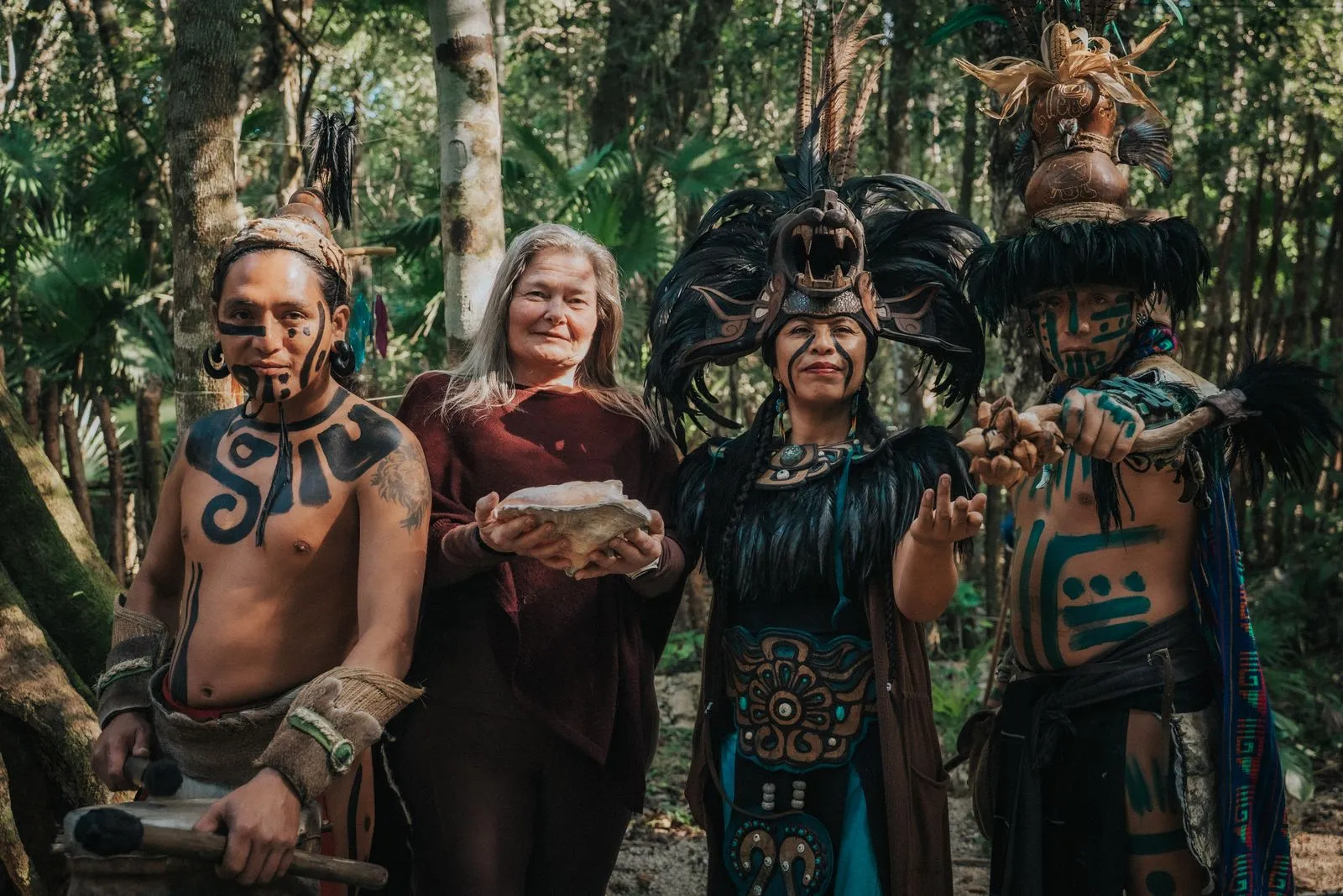
Every woman carries her mother line whether she tends it or not: patterns of care and silence, strengths never named, wounds that arrived already old. A women’s ancestral healing retreat is time set aside to look at that inheritance directly, in a circle of women doing the same, with practices older than any of it.
Why women’s work is its own room
Mixed ancestral work is real and we hold it too. But something specific becomes possible when the circle is women only: the material that surfaces is different, the speed at which strangers become witnesses is different, and the themes that recur, mothering and being mothered, the bodies of the line, what the grandmothers survived and what surviving cost, get room they rarely get elsewhere. Women describe saying things in circle they had never said aloud, not because the words were forbidden but because no room had ever been shaped for them.
The practices
The work here is done through experience rather than analysis. Ceremony anchors it: cacao circles where the sharing happens, fire ceremonies for what is being released, temazcal, the sweat lodge that is itself a womb in the tradition that built it, held with care and heat and song. Around the ceremonies sit the quieter forms: guided lineage meditations, writing that nobody has to read aloud, movement and breathwork for what words do not reach, and the jungle itself, which does more of the holding than any schedule shows. Nothing is performed and nothing is mandatory; a woman who spends one ceremony simply sitting near the fire has done the work exactly as much as anyone.
What surfaces, honestly
Grief, often, including grief nobody expected: for grandmothers barely known, for versions of a mother that never existed, for the woman one might have been in an easier line. Anger with old roots. And regularly, unexpectedly, gratitude, the discovery that the line carried gifts as stubbornly as it carried wounds, and that endurance itself was one of them. The circle holds all of it without fixing any of it, which is the point: this is not therapy and does not claim to be, and a woman working with a therapist will find the two complement rather than compete. When the grief has moved through and something lighter wants to be seen, the Soul Shine retreat picks up there, an invitation to return to your own radiance for alignment rather than applause.
What days look like
Mornings open gently, movement or breath, never before the body is ready. One held experience anchors each day. Afternoons are unclaimed: the cenote-fed pool, the paths, rest, the conversations that start on their own between women who were strangers on Monday. Evenings belong to circle or ceremony as the retreat builds toward its deeper work mid-week, and the last day is deliberately soft, because integration begins before departure, not after.
Who comes
Women at thresholds: after a mother’s death, before or after becoming one, at the end of caretaking, in the middle of a life that suddenly asked whose script it was running. Women who have done inner work for years and keep arriving at the same inherited room. And women who simply feel the pull without a story attached, who are always the ones most surprised by what the week gives them.
This work sits within our spiritual awakening retreats, where ceremony and lineage practice are held together.
The wider container for this work is our sacred feminine healing retreat for women, where lineage is one thread among several.
The wider movement behind this work is described in our feminine healing retreats piece on the rise of the medicine woman.
The broader practice of lineage work at Lunita, open to everyone, is described in our ancestral healing retreat guide, and the ceremonies that anchor this work, temazcal, cacao and fire, are explained in sacred ceremonies in Mexico.