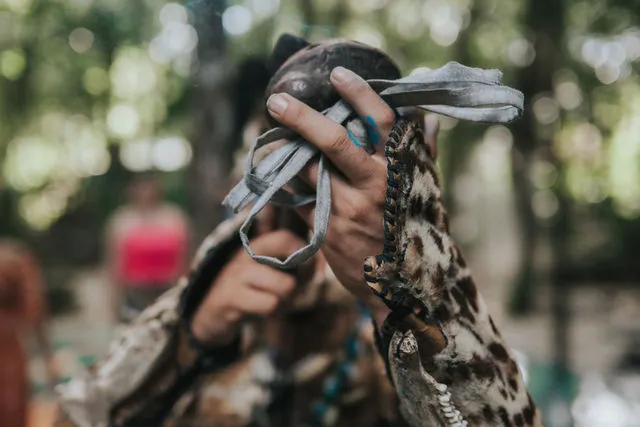
People are drawn to peyote and mescaline for healing, most often around anxiety, depression, trauma, and a search for meaning, and traditional practice plus a small body of research suggest real potential. But honesty matters here: modern clinical evidence for mescaline is genuinely thin, far behind psilocybin or ayahuasca. This is what's actually known, held alongside the traditional understanding. At Lunita, peyote is encountered only within a Wixárika-led ceremony, never as a casual wellness add-on. (New to the medicine? See what peyote is.)
Mescaline: the active compound
Mescaline is a naturally occurring psychedelic alkaloid and a serotonin 5-HT2A receptor agonist, the same broad receptor family engaged by psilocybin and LSD. Activating those receptors temporarily reorganizes brain activity, which is associated with altered perception, emotional openness, and the capacity to see familiar things from a new angle. Its effects are often described as gentle and introspective relative to other psychedelics.
What the research actually shows
The most rigorous evidence comes not from clinical trials but from observational study of ceremonial use. In a 2005 study, researchers examined Native American Church members who had used peyote regularly in a religious context and found no evidence of psychological or cognitive deficits, and several mental-health measures scored better than non-using peers (Halpern et al., 2005, Biological Psychiatry). That's meaningful for safety in a traditional context, but it is not a trial of mescaline as a treatment. Beyond it, formal clinical data is sparse, and most therapeutic claims rest on traditional knowledge and individual reports.
What people report, held honestly
Within traditional and anecdotal contexts, people describe improvements in anxiety and depression, help processing trauma (revisiting difficult memories from a steadier vantage), and support in addiction recovery through insight into root causes, alongside spiritual benefits like clarity, self-understanding, and a felt sense of interconnectedness. These reports are real and worth taking seriously, but they are not the same as established efficacy. Peyote is not an approved treatment, and it is not a substitute for professional mental-health care.
Safety and who should not use it
In a screened ceremonial setting serious adverse events are rare, but the contraindications are firm: SSRIs and other serotonergic medications, serious heart conditions, a personal or family history of psychosis or schizophrenia, and pregnancy. Set, setting, screening, and experienced guidance matter enormously, which, with peyote specifically, means the Indigenous-led ceremonial context itself.
Where Lunita fits
Lunita doesn't offer "mescaline therapy." What it offers is a respectful container for a Wixárika-led peyote ceremony with integration support, and, for plant-medicine work Lunita facilitates directly, bufo and ayahuasca within a personal retreat.
This article is informational and not medical advice. Peyote/mescaline is not an approved treatment. If you're managing a health condition, consult a qualified professional.
Learn more about our sacred ceremonies.