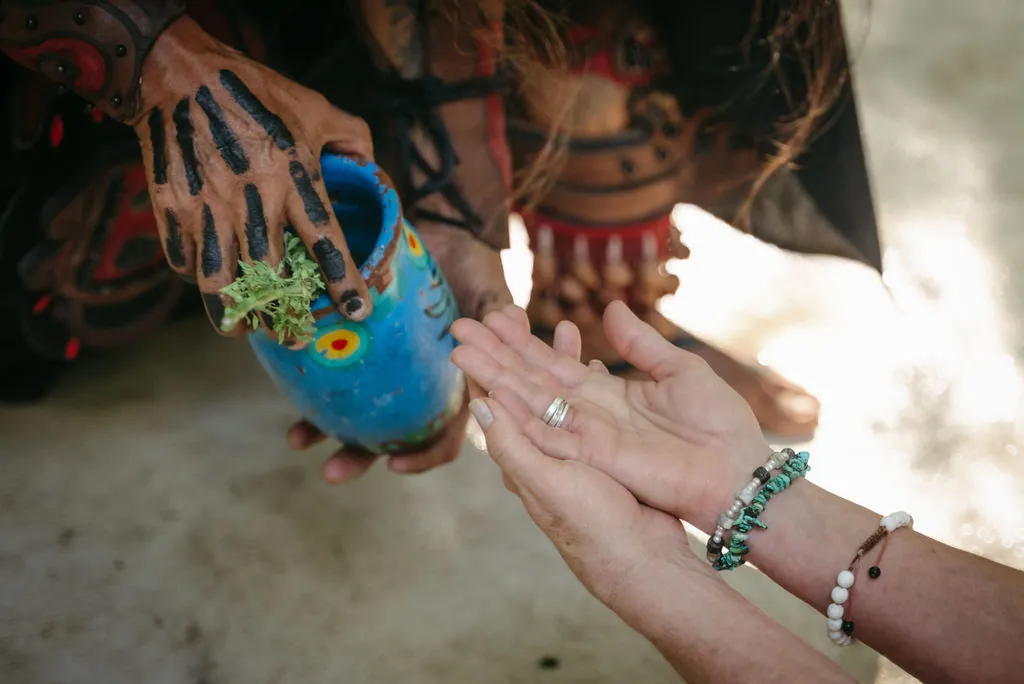
We carry more than our own experiences, patterns, strengths, and wounds move through family lines across generations. An ancestral healing retreat is time set aside to honor that lineage and gently release what no longer serves. Here's what it involves. (See ceremony at Lunita.) Wikipedia summarises the research and the debate around transgenerational trauma, which is the closest clinical language for what this work approaches through ritual.
What happens at an ancestral healing retreat?
Through ceremony, reflection, somatic practice, and ritual, ancestral healing helps you acknowledge inherited burdens and reconnect with the gifts that also flow through your line. It's not about genealogy or facts, it's about the felt patterns and emotions you carry now, and gently shifting them.
Healing forward
Lineage work lands differently in a circle of men, which is why we hold spiritual retreats for men as their own room.
For women following the mother line specifically, our women’s ancestral healing retreat gives that thread its own days.
When two lineages sit in one relationship, our couples ancestral healing retreat describes what the days hold for both of you.
This is emotional and spiritual work, a way to heal not only for yourself, but for those who came before and those who come after. This is offered as a spiritual and emotional experience, complementary to, and not a substitute for, medical or psychological care. Explore a personal retreat or book a discovery call.
What the days hold at a lineage retreat
The first day is arrival and little else. You reach the land, drink water, find your cabana and let the drive fall away. Lineage work asks for a settled body before it asks for anything else, so nothing is scheduled that evening beyond a meal and the dark.
The middle days carry the work: a morning practice in the glass shala, a circle or a session with the facilitator, time to write, and a ceremony held with room on either side of it. Some people bring a photograph or an object from a grandparent. Nobody has to.
The last day is for landing. A slow morning, a walk, a conversation about what to keep tending at home. Then the drive back to Cancun, about forty minutes of road, which works as the closing threshold.
Who comes to lineage work, and what should you bring?
People come at a turn: after a parent dies, before a child is born, when the same pattern shows up in a third relationship in a row. Many know almost nothing about their family beyond two generations, and that is common rather than a problem.
Bring something that belonged to your line if you have it, a notebook, and clothes for heat and for a wet evening. Leave the expectation of a single dramatic moment. What people describe is quieter: a sentence they have carried for years said out loud, and a body that stops bracing around it.
How Lunita holds ancestral work
At a personal scale. Eight cabanas and a mini apartment, at most twenty guests, and a private cenote about ten minutes away where a facilitator can hold a water ritual with nobody else in sight. The property was built with ceremonies of permission to the land, which is a fitting place to ask permission of your own.
The days can be yours alone, shaped with a facilitator, or part of a group a leader brings. Either way the ceremony has quiet on both sides of it, and the kitchen, the pool and the dark do the rest.