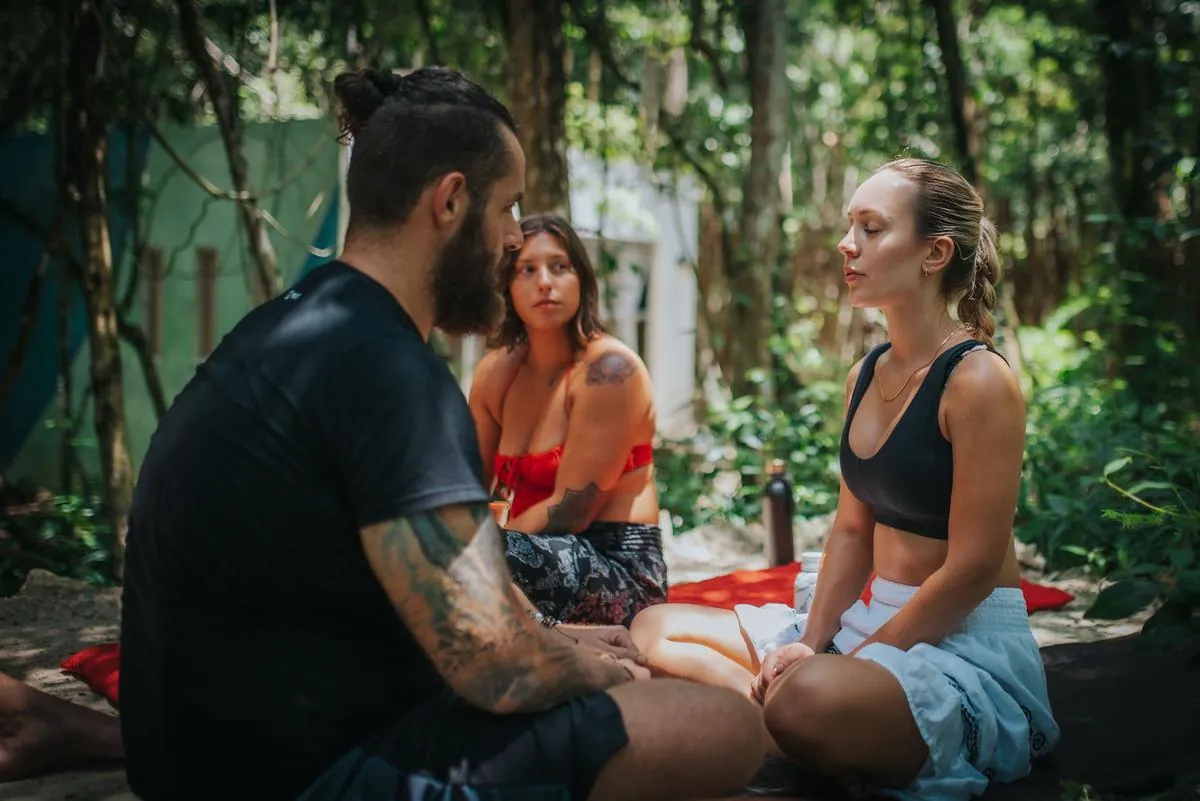
A Sacred Breath & Somatic Release session is a trauma-informed practice that combines conscious breathing, somatic release, and sound healing to dissolve tension and restore clarity. Offered at Lunita near Cancún, it draws on Neo Emotional Release® (NER), a method that gently accesses and integrates emotions held in the body, supported by open-air spaces and the rhythm of the jungle. Here's how it works. (It sits within the wider somatic work at Lunita.)
The three phases
Sacred Breath: guided diaphragmatic and rhythmic breathing to activate energy and expand awareness. Neo Emotional Release® (NER): a trauma-informed somatic process that helps release emotion and free what feels blocked. Sound integration: vibrational instruments (crystal bowls, chimes, grounding sounds) soothe the nervous system and anchor the experience. The result is a journey that can leave you lighter, calmer, and more connected to yourself.
Why breath and body together
Slow, rhythmic breathing supports the body's relaxation response, and somatic methods work with the body rather than only talking about experience, reaching layers that insight alone often can't. Held as a gentle, trauma-informed practice (not a medical treatment), it's a powerful complement to breathwork, sound healing, and a personal retreat.
A note on care
Because this work can surface strong emotion, it's facilitated with care and adapted to you, please share any significant health conditions or trauma history beforehand. It supports wellbeing but doesn't replace clinical mental-health care where that's needed.
The retreat form of this practice, held daily rather than once, is described on our breathwork retreat in Mexico page.
Work like this is best held with time around it; a personal retreat gives it exactly that.
How to prepare for a Sacred Breath session
Eat lightly two to three hours before, and drink water through the day rather than right before you lie down. Wear loose clothes you can breathe in, and bring a layer, because the body cools once the breathing slows.
Come with a question rather than a goal. A goal sets the session up to fail; a question gives what surfaces somewhere to go. If you have a history that the breath might touch, say so to the facilitator before you begin, in as few or as many words as you want.
Afterward, keep the next hour or two empty. Water, food, a slow walk on the paths or a float in the cenote-fed pool. The session is not over when the sound stops.
Where the session is held at Lunita
Sessions run in the octagonal glass shala, with the canopy on every side, or in an open-air space when the group is small and the weather is kind. Either way the jungle is the sound under the bowls. A mat, a bolster and a blanket are set for you; there is nothing to bring.
On a personal retreat the session can be one person and the facilitator. In a hosted group it is rarely more than twelve, and never more than the property holds, which is twenty guests across eight cabanas and a mini apartment. The number matters, because somatic release in a crowd is a different and lesser thing.