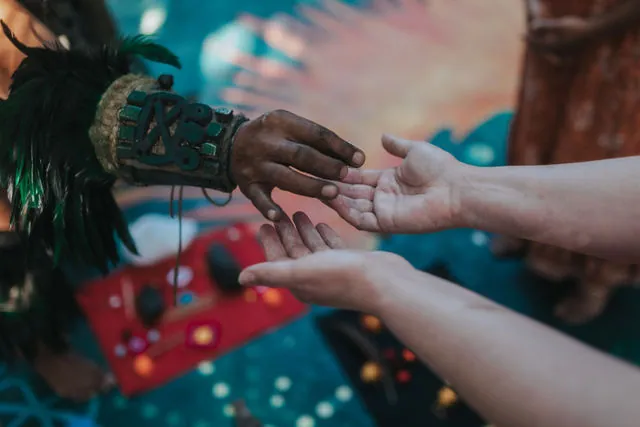
The history of sacred mushrooms runs from Mesoamerica to Maria Sabina: three thousand years of ceremony, one magazine article, and a lineage still held in Oaxaca. Long before anyone called them psychedelics, mushrooms were medicine, and the people who used them called them by names that made the relationship plain. In Nahuatl, the language of the Aztecs, teonanacatl: usually rendered as flesh of the gods. This is the story of how sacred mushrooms have been held across cultures, told with the respect the living traditions deserve.
The Mesoamerican record
The deepest evidence is in Mesoamerica. Carved mushroom stones from the Guatemalan highlands and the Pacific slope date back roughly three thousand years, small figures with a mushroom cap for a head, found in enough numbers to suggest an established practice rather than a curiosity. By the time the Spanish arrived in the sixteenth century, the Aztecs were using teonanacatl in ceremony, and the chroniclers wrote it down: Sahagun described the mushrooms eaten with honey at feasts and the visions that followed, and the friars, alarmed, worked to suppress the practice as idolatry. Sahagun's account survives in the Florentine Codex, and the Codex Vindobonensis Mexicanus 1, a Mixtec screenfold made before the conquest, shows the mushrooms handled in ritual: two records, one written under Spanish supervision and one that owes the Spanish nothing. It did not disappear. It went quiet, into the mountains, into the hands of families who kept it for centuries without anyone outside knowing.
The Mazatec tradition
In the Sierra Mazateca of Oaxaca the practice survived intact. The Mazatec healers, the curanderos and curanderas, worked with the mushrooms in night ceremonies called veladas: a candle, chant, prayer, the mushrooms taken in pairs, the healer holding the space through the night for the sick person and their family. The mushrooms were not recreation and not philosophy; they were a way of seeing what was wrong and how to mend it, inside a cosmology that predated the Spanish and had absorbed the Catholic saints without surrendering its center. This is the lineage our own mushroom ceremony belongs to, and it belongs to it specifically: the mushrooms are Mazatec medicine, held in the Mazatec way.
1957, and what the world did with it
The modern chapter opens with a single article. In 1955 the American banker and amateur mycologist R. Gordon Wasson took part in a velada held by Maria Sabina in Huautla de Jimenez. In 1957 Life magazine published his account, Seeking the Magic Mushroom, and a practice that had been hidden for four centuries was suddenly known to millions. The consequences fell hardest on the people who had kept it. Seekers arrived in Huautla by the thousands, the town was overrun, and Maria Sabina, who had shared the ceremony in good faith, spent her later years saying the mushrooms had lost their purity once they left the hands of the healers. Her lament is part of the history and the tradition insists on remembering it.
Other cultures, other mushrooms
Mushrooms in ceremony are not only a Mesoamerican story, but the record elsewhere is thinner and often concerns a different mushroom entirely. Siberian peoples used Amanita muscaria, the red fly agaric, in shamanic practice, a mushroom with different chemistry and different effects from the psilocybin species of the Americas. Claims about ancient Europe, Egypt or the Vedic soma remain contested and should be read as hypotheses, not history. The honest map is this: the strongest, oldest, best-documented living tradition of sacred mushroom ceremony is the one still practiced in the mountains of Mexico.
What the lineage asks now
Interest in psilocybin has returned in the twenty-first century through research and through retreats, and the temptation is to treat the mushrooms as a technique with a tradition attached for atmosphere. The traditions ask the reverse: that the ceremony be held by people who carry the lineage, that preparation and integration be part of it, and that Maria Sabina's warning be taken seriously by anyone who sits with the medicine. At Lunita, the mushroom ceremony is held in that spirit, and you can read what it involves on our sacred mushroom ceremony page. History is not decoration for the ceremony. It is the reason the ceremony exists.