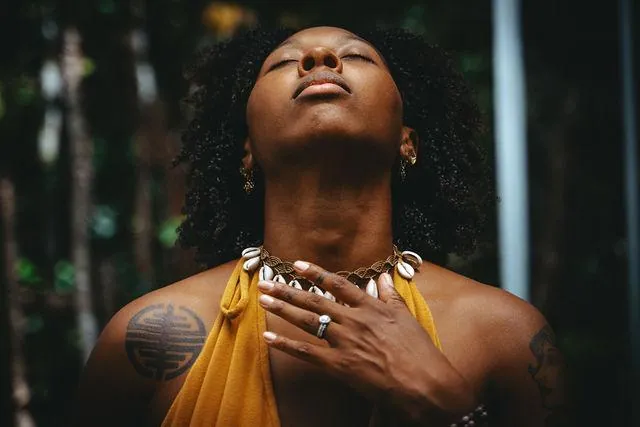
A breathwork retreat in Mexico is a stay built around guided conscious breathing, and what a session does is settle the nervous system and reach what talking cannot. Breath is the only function of the body that runs itself and also takes instruction. That doorway is why breathwork exists: change the breath deliberately for long enough and the body, then the mind, follow it somewhere they would not go on their own. People come out of a session having cried, laughed, shaken, gone somewhere wordless, or simply felt, for the first time in years, fully inside their own body.
What a session actually involves
You lie down. A facilitator guides a breathing pattern, often a connected, circular breath with no pause between inhale and exhale, sometimes with music, sometimes with silence, for anywhere from thirty minutes to over an hour. The breath is the whole technique; there is nothing else to do. Within ten or fifteen minutes the body begins to respond: tingling in the hands, waves of heat or cold, emotion arriving without a story attached, images, or a deep stillness underneath the intensity. The facilitator holds the room, adjusts pacing, and stays close to anyone in strong release. Then the breath slows, the body settles, and a long rest follows in which most of the integration happens.
Why it reaches what talking cannot
Much of what people carry does not live in words. It lives in a held jaw, a chest that never fully exhales, a startle that arrives before any thought. Talking about those things is talking around them. Breathwork goes through the body to the place they are stored, and what surfaces surfaces as sensation first. This is why the practice belongs alongside ceremony rather than alongside lectures, and why our guests describe it as the session that opened whatever the week then worked with.
The styles held at Lunita
Conscious connected breathwork for release and depth, usually in a group, lying down, music guiding the arc. Gentler pranayama within yoga practice for regulation and steadiness. Breath paired with cold water at the cenote, which teaches the nervous system a range it forgot. And breath as ceremony, held with intention and song, which is the form our breathwork facilitators bring from their own lineages. Nobody is pushed into intensity; the facilitator meets each person where their breath is that day.
Who it suits, and who should speak first
People who think and analyze for a living, whose minds will not go first into anything. People in recovery from long stress. People who have done years of talk-based work and keep reaching the same wall. And anyone curious about ceremony who wants a first experience with no substance involved, because breathwork is exactly that. Anyone pregnant, with a heart condition, epilepsy, or recent surgery should speak with the facilitators beforehand, honestly; gentler forms are always available and the strong forms are never mandatory.
Why the jungle is the right room
Breathwork amplifies whatever the environment gives it. In a city studio, the environment gives traffic and the next appointment. In the jungle, it gives canopy sound, real darkness at night, warm air, and the knowledge that nothing is expected of you afterward except rest. Sessions here happen in the Crystal Shala with glass on every side or under the trees, and the release that follows has somewhere to go: the pool, a hammock, the paths, silence.
Where it sits in a stay
The trauma-informed, three-phase form of this work is our somatic breathwork retreat, held with extra care.
Breathwork runs within most of our retreats and can anchor a stay on its own. It pairs naturally with yoga nidra and sound baths for the rest that follows release, and with the ceremonies described in sacred ceremonies in Mexico for those going deeper. As a practice it is central to our spiritual awakening retreats, where it is taught daily rather than sampled once.
Where breath works from the inside, reiki and vibrational massage work on the body from without, and the two often sit in the same day.